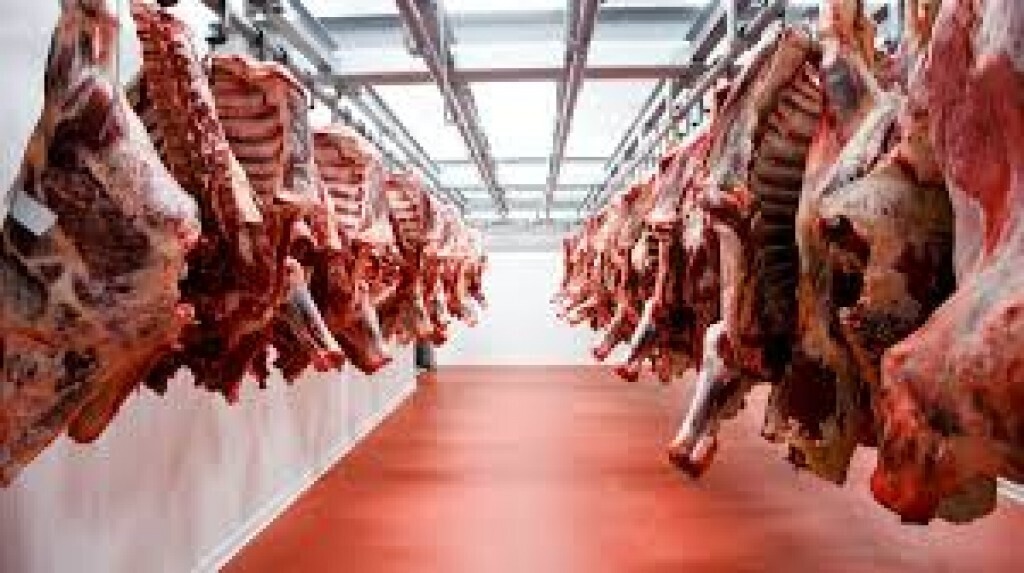
The price of meat has risen by an average of 15% in recent weeks, and the outlook is for it to continue to rise due to a shortage of supply and prospects for external demand, according to sector sources.
"Meat has risen 15% since October. The reality is that we have to gradually move towards international prices. Prices will stabilize, they will not go down and they will continue to rise," said Sergio Pedace, vice president of the Argentine Chamber of Butchers and Suppliers, in statements to the Argentine News Agency.
He added that "today the Cañuelas Agro-livestock Market remained very firm on prices, with 8,000 heads." In this context, he stated that despite the price increase, sales at the counter are holding up: "We are not yet seeing it reflected so strongly," he assured.
"The United States requires heavy steer, fat 3, that is fat."
The Argentine Center for Political Economy (CEPA) analyzed the price of meat and observed that "towards the end of the year an acceleration was seen again: the price increased by 4.4% in October and by 11.4% in the first ten days of November, anticipating a new stage of strong adjustments in the retail market."
In this sense, it pointed out that "the decline in domestic consumption of beef is directly associated with the loss of purchasing power of income."
Buenos Aires, November 18 (NA) -- The price of meat has risen by an average of 15% in recent weeks and the outlook is that it will continue to rise due to the scarcity of supply and the prospects of external demand, according to sector sources.
All this makes the producer bet on livestock.
He also pointed to the external demand for Argentine meat: "the Chinese have started to buy bife de chorizo, they are trying good meat" and said that "in this context we are going to run out of cows" because "there are fewer livestock fields."
On the other hand, he explained that "in Argentina they slaughter very small animals, of 300 kilos and in the world they work with livestock of 500 kilos."
He added that "a pizza costs 35,000 pesos so people still see that meat is cheap because the minced meat costs 9,000 pesos a kilo, so you can defend yourself a bit."
In this regard, he noted that the increase has an impact depending on the cut of meat.
"A limited salary evolution explains, to a large extent, the lower consumption capacity of households and the consequent contraction in the demand for beef."
According to the Chamber of the Meat Industry and Commerce (CICCRA), the 12-month moving average of per capita consumption of beef for September 2025 was 49.5 kg/year.
Even so, this level is 7.3% below the same period in 2023.
Regarding the average of the 12 previous months, the improvement was 4.4%.
He said that "there is a seasonal issue, now people start to buy more milanesa, something for the grill, barbecue so what is the chest part of the animal, which is used for stew, starts to sell less and they put less increase and they put more on the back part of the animal."
In this way, he stated that "there are cuts that rise more than the average" and observed that "the Argentine buys before, because of the inflation that there was and because he knows that there will be increases."
Pedace considered that to recompose the livestock stock it is necessary "a predictable policy like now, that there is a course, that they don't lie to the producers, that they don't close exports, that the dollar is free."